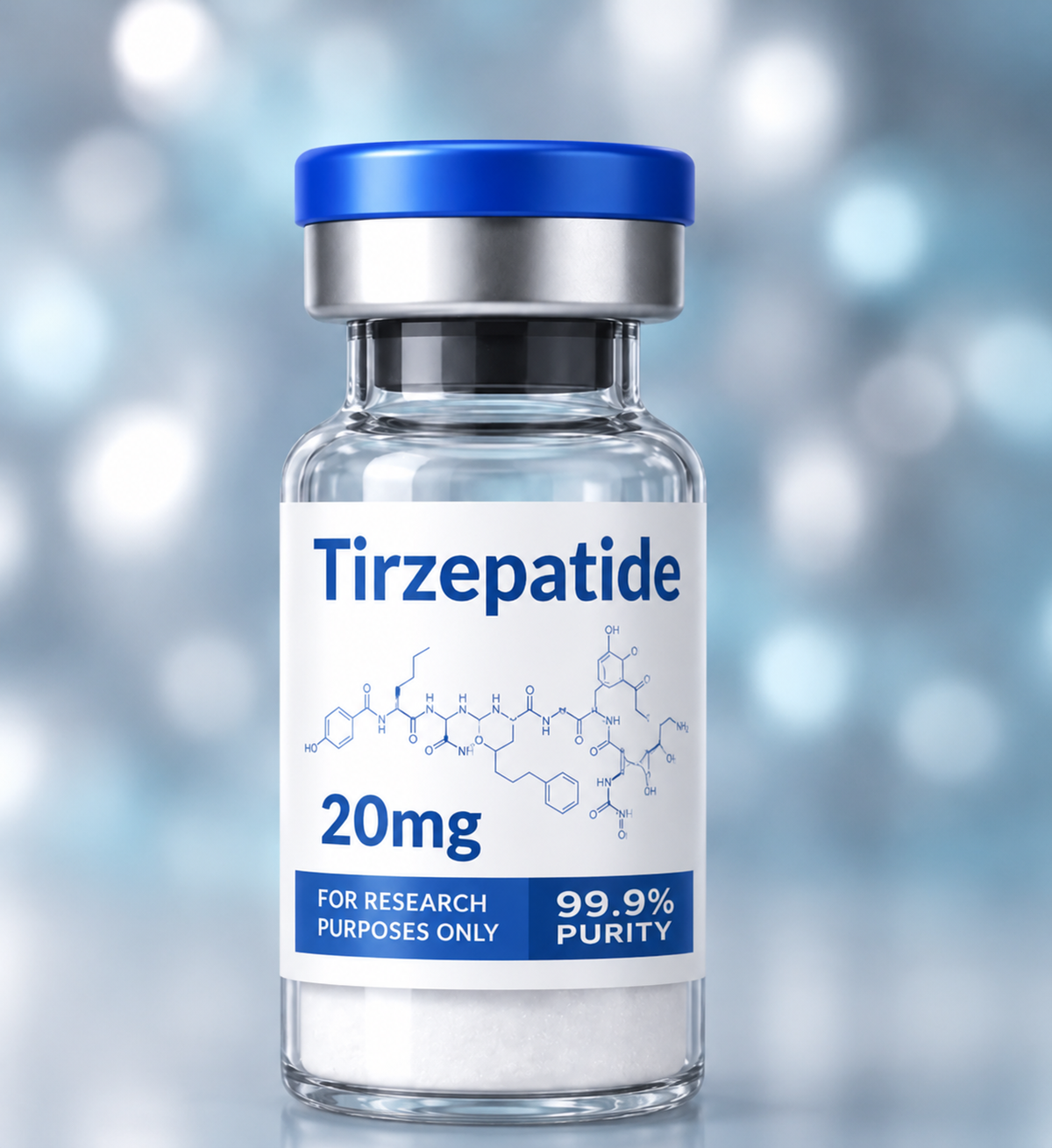
CorePeptides India ships Tirzepatide as a sterile, lyophilized powder - 5 mg per nitrogen‑flushed borosilicate vial. Every single vial carries a printed Certificate of Analysis. That COA is batch‑matched, HPLC‑verified, and mass‑confirmed. Nothing ships without it.
Product Specifications
| Specification | Detail |
|---|---|
| Product Class / Category | Dual GIP / GLP‑1 Receptor Agonist Research Peptide |
| Research Identifier | Tirzepatide, CAS 2023788‑19‑2 |
| Supplier / Brand | CorePeptides India |
| HPLC Purity Threshold | >99% (RP‑HPLC, C18 column, 214 nm) |
| Target Receptors / Chemical Pathways | Glucose‑dependent insulinotropic polypeptide receptor (GIP‑R) and glucagon‑like peptide‑1 receptor (GLP‑1R) - biased in‑vitro agonism at GLP‑1R with preferential cAMP over β‑arrestin recruitment; GIP‑R binding affinity 7–10‑fold lower than native GIP in cell‑based assays |
| Regulatory Status | For In‑Vitro & Laboratory Analytical Research Only. Not for human or veterinary administration, diagnostic use, or therapeutic application. |
Research Overview & Mechanism of Action
Tirzepatide is a 39‑amino acid synthetic peptide containing an acylation tag. A C20 fatty diacid moiety - eicosanedioic acid - is conjugated to the lysine side chain at position 20 through a glutamic acid‑mini‑PEG linker. This architecture yields strong albumin binding in serum‑containing assay buffers and significantly slows dissociation kinetics at both target receptors. Molecular weight: 4813.5 g/mol (free base). The sequence spans a core GIP scaffold engineered with strategically placed substitutions that tilt GLP‑1R signalling bias toward cAMP accumulation over β‑arrestin recruitment. That bias matters in receptor trafficking studies.
In vitro, the peptide activates GIP‑R with roughly 7‑10‑fold lower potency than native GIP while retaining full cAMP‑response efficacy. At GLP‑1R, it acts as a full agonist with a potency comparable to native GLP‑1. Dual‑receptor engagement makes Tirzepatide a crucial tool for mapping cross‑talk between incretin receptor pathways in β‑cell lines, primary pancreatic islet cultures, and recombinant receptor systems. Researchers who run concentration‑response curves should expect an EC50 shift depending on albumin content in the assay medium- a direct consequence of the fatty acid conjugation that prolongs dissociation. The lyophilized cake often arrives fragmented after transit. That’s irrelevant to purity. The mass‑spec trace and HPLC chromatogram are what count.
Handling, Reconstitution & Storage Protocol
Lyophilized Tirzepatide is stable at –20 °C for long‑term storage. Shipment at ambient temperature for up to 5 days has been validated internally without detectable degradation. Once you receive the vial, let it equilibrate to room temperature for 20 minutes before opening. Skipping this invites condensation that can encourage aggregation of the acylated peptide.
Reconstitution for analytical research:
- Recommended diluent: sterile phosphate‑buffered saline (PBS), pH 7.4, or sterile bacteriostatic water.
- Target a stock analytical concentration of 1–2 mg/mL. Inject the solvent gently against the glass wall and swirl. Do not vortex. The fatty acid moiety makes the peptide somewhat amphiphilic; vortexing promotes interfacial aggregation and foaming.
- If your protocol calls for nanomolar to low‑micromolar working solutions in cell‑culture plates, pre‑coat pipette tips and tubes with a 0.01% BSA solution to minimise adsorptive loss of the acylated peptide to plastic surfaces. Adding 0.05–0.1% BSA directly to the assay buffer can stabilise the molar ratio of free peptide during extended incubations.
Post‑reconstitution storage: keep the solution at 2–8 °C and use within 2‑3 weeks. Single‑use aliquots are mandatory. Avoid repeated freeze‑thaw cycles. One cycle can reduce the intact peptide signal by approximately 15%, based on our in‑house stability assessments using LC‑MS quantitation. Plan aliquots around your experimental design, not convenience.
Scientific References & External Citations
- PubMed: Tirzepatide Dual Agonist Research -Peer‑reviewed in‑vitro pharmacology and receptor binding studies.
- PubChem Compound: Tirzepatide- Structural identifiers, molecular weight, and chemical properties.
- ClinicalTrials.gov: Tirzepatide Investigator‑Initiated Trials -Registered protocols exploring the peptide in controlled clinical research environments.
Frequently Asked Research Questions
What is the molecular structure and receptor selectivity of Tirzepatide?
Tirzepatide is a 39‑amino acid acylation‑modified peptide with a C20 fatty diacid chain at the lysine‑20 residue. Its molecular weight is 4813.5 g/mol. In vitro, it acts as a full agonist at both GIP‑R and GLP‑1R, with biased signalling at GLP‑1R favouring cAMP accumulation over β‑arrestin recruitment. This selectivity profile is confirmed via HEK293 overexpression models and primary β‑cell assays.
How should I reconstitute Tirzepatide for receptor binding studies?
Use sterile PBS, pH 7.4, to prepare a 1–2 mg/mL stock. Let the lyophilized powder warm to room temperature first. Add diluent slowly and swirl gently - avoid vortexing. For low‑nanomolar working solutions, include 0.05–0.1% BSA in the assay buffer to limit peptide loss to plasticware. The acyl chain makes Tirzepatide moderately amphiphilic; careful handling preserves the correct molar ratio throughout an incubation.
Is a batch‑specific Certificate of Analysis provided by CorePeptides India?
Yes. Every 5 mg vial comes with a printed and digitally archived COA. The report includes the RP‑HPLC purity reading, retention time, ESI‑MS mass confirmation, and residual solvent profile. The lot number on the vial links directly to that COA.
Can Tirzepatide be used for human metabolic or therapeutic research?
No. CorePeptides India supplies Tirzepatide exclusively for in‑vitro laboratory research. It is not manufactured for, nor authorised for, human or veterinary administration, diagnostic procedures, or clinical therapeutic development. All purchase orders are reviewed to uphold this restriction.